Will a Personal Loan Help Your Credit Score? What Bad-Credit Borrowers Should Know

Here's the counterintuitive part most people miss: a personal loan can raise your credit score or sink it, and the deciding factor isn't the loan itself. It's what you do with the money and whether every payment lands on time.
If your credit is already bruised, that nuance matters even more. The same loan that pulls one borrower's score up by leveling off their credit card balances can drag another's down through a missed payment and a fresh pile of debt. Let's walk through exactly how the math works, so you can tell which side of that line you're on before you borrow.
Why this matters right now
Borrowing costs are still elevated. Bankrate's current personal loan rate data shows a typical advertised APR range of approximately 8% to 36%, with an average rate of 12.41% — but that average hides a wide spread. From a financial standpoint, your credit profile is one of the most important factors affecting the rate you may receive, along with your income, existing debts, requested amount, loan term and the lender's underwriting criteria.
Personal loan offers for borrowers with bad credit can reach approximately 36% APR, depending on the lender and applicant profile.
What this means for you: A lower credit score generally leads to fewer available offers and a higher APR, but your score is not the only factor. Lenders may also consider your income, existing debts, requested amount, repayment term and overall ability to repay.
Meanwhile, credit card rates remain far higher. Federal Reserve data shows a substantial rate gap between the two products. The average rate on 24-month personal loans at commercial banks was 11.86%, compared with 22.15% for credit card accounts that were assessed interest . That difference is one reason a consolidation loan can reduce borrowing costs, provided the borrower qualifies for a sufficiently low APR and does not extend repayment for too long.
How a personal loan actually moves your FICO score
Your FICO score breaks into five weighted factors : payment history (35%), amounts owed (30%), length of credit history (15%), new credit (10%), and credit mix (10%). A personal loan touches four of those five. Here's where the math gets interesting — it pushes in opposite directions at the same time.
The lever that helps most: utilization
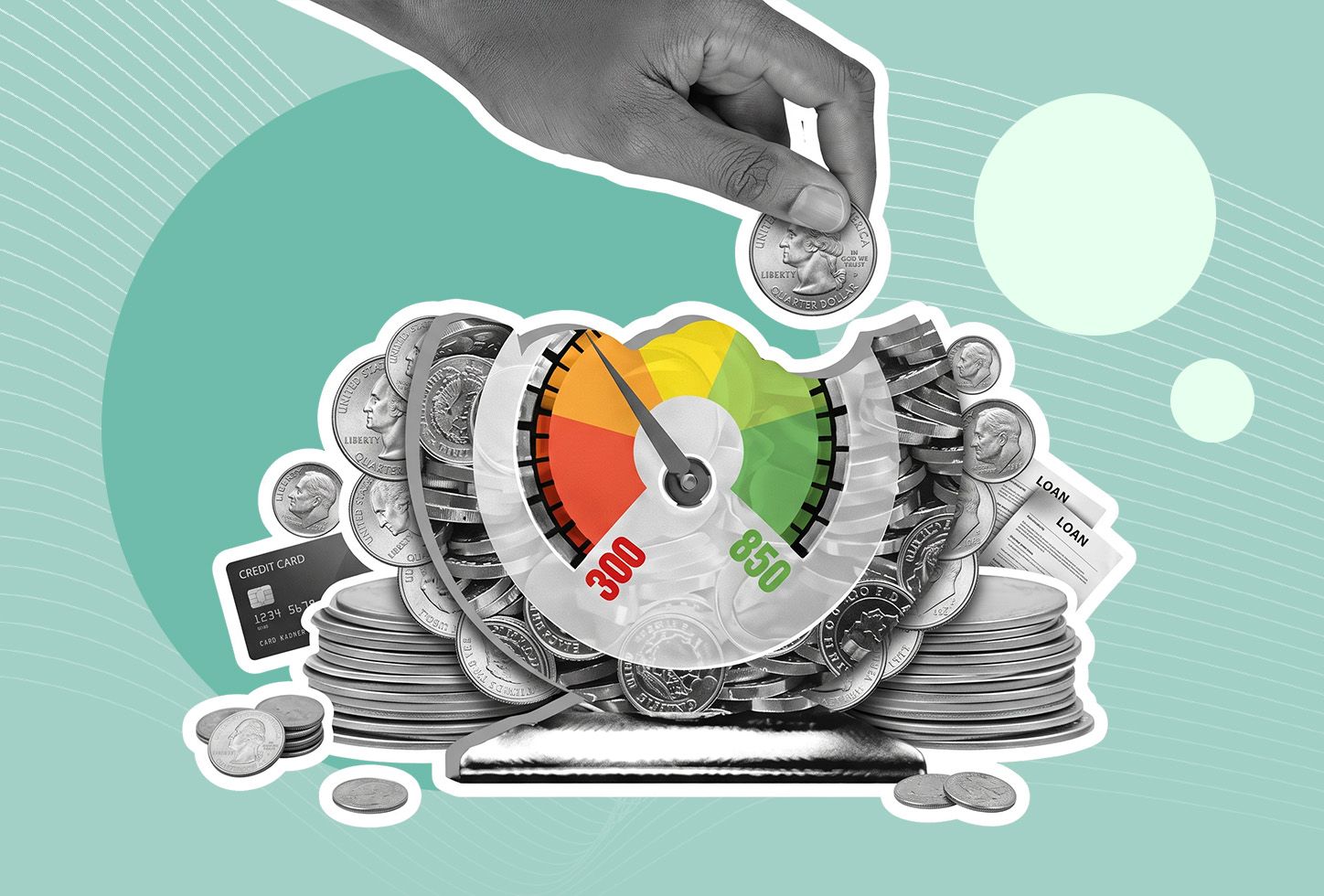
Credit utilization — how much of your revolving credit limit you're using — is the heavyweight inside the 30% "amounts owed" category. A personal loan is an installment loan, so it doesn't count toward utilization the way a credit card balance does. When you use loan proceeds to wipe out card balances, your utilization can drop sharply, and that's frequently the fastest positive move available to a bad-credit borrower.
There is no universal utilization threshold that guarantees a particular score increase. Lower revolving utilization is generally better. Many experts recommend staying below 30% of your available limits, while people with the strongest credit profiles often use less than 10%. The effect of any reduction depends on the rest of your credit report. If consolidating cards takes you from 80% utilization down toward single digits, that shift may improve your score, although the size and timing of the change cannot be predicted in advance.
The lever that hurts (a little, and usually briefly)
A full application may trigger a hard inquiry, which can cause a small, temporary score decrease, although the effect varies by credit profile. Hard inquiries can remain on your credit reports for up to two years, while FICO generally considers inquiries from the previous 12 months. Opening the account may also reduce the average age of your accounts, a short-term drag on the 15% "length of history" factor. Their influence generally diminishes as the account ages and the inquiry becomes older.
The lever that decides everything: payment history
Payment history is the largest major category in a typical FICO Score, at 35%. Consistently paying the loan on time can support a positive payment record, but no individual payment guarantees a score increase. A payment reported 30 days late or more can cause substantial damage, especially when the delinquency is recent or the borrower previously had a clean history. This is the make-or-break: a consolidation loan that lowers your utilization but then catches a missed payment can leave you worse off than when you started.
Share of a FICO Score driven by payment history (myFICO)
What this means for you: Before you borrow, set up autopay. The entire credit benefit of a personal loan rests on a clean payment record, and automating it removes the most common way that record breaks.
A concrete example: does the math work?
Say you're carrying $8,000 in credit card debt at around 22% APR and paying $250 a month. This is where the math gets interesting. Left on the card, that balance takes about four years to clear and costs roughly $4,000 in interest along the way.
Now assume you qualify for a three-year consolidation loan at 20% APR — a realistic quote for a fair-credit borrower. The payment lands near $297 a month, and total interest comes in around $2,700. You'd pay a bit more per month, clear the debt a year sooner, and save roughly $1,300 in interest. On top of that, moving $8,000 off your cards is the utilization drop that can lift your score.
This example assumes there is no origination fee. If the lender deducts a fee from the loan proceeds or adds it to the amount financed, the effective cost will be higher and the expected savings may be smaller.
Think of it this way: The loan's value here isn't just the interest saved. It's that you've converted revolving debt (which pounds your utilization) into installment debt, which is not included in revolving credit utilization but still appears as debt on your credit reports — and you've locked in a fixed payoff date instead of an open-ended minimum-payment treadmill. You can sketch your own version with our free loan calculator .
One caveat worth flagging: a lower APR doesn't always mean lower total cost. Stretch that same balance over five or seven years and you can pay more in total interest at the lower rate than you would have at the higher one over three. The rate is only half the equation — the term is the other half.
Where borrowers get it wrong
Let's be honest: the most common mistake isn't choosing the wrong lender. A common consolidation mistake is paying off the cards and then building the balances back up. The consolidation loan sits on top of the credit report as new debt, the old card balances creep back, and now there are two problems instead of one. Utilization climbs again, total debt is higher than before, and the score gains evaporate.
The fix is a decision rule, not willpower. After consolidating, consider keeping paid-off cards open if they have no burdensome annual fee and you can avoid using them for new debt. Keeping available limits open may help preserve a lower utilization ratio. However, closing a card may still be appropriate when it carries a costly fee or keeping it open would make overspending more likely.
What's the right move for your situation?
Situation: High credit card balances, high utilization, score dinged mainly by amounts owed.
Best move: A consolidation loan is most likely to help you — the utilization drop is your fastest lever.
Why: You're trading revolving debt that hurts utilization for installment debt that doesn't, while cutting interest. Just don't reload the cards.
Situation: Few accounts, limited history, score held back by a thin file rather than by debt.
Best move: A small loan you can comfortably repay can add installment history and diversify your credit mix — but only borrow if you have a real use for the funds.
Why: Credit mix is just 10% of your score. Taking on interest costs purely to "build credit" rarely pencils out; the benefit is modest and the debt is real.
Situation: One or more recent late payments; score damage driven by payment history.
Best move: Stabilize first. A new loan won't undo a recent delinquency, and adding a payment obligation before you're current raises your risk.
Why: Payment history is 35% of your score. Until your existing accounts are current and staying current, a new loan adds exposure without fixing the root problem.
The trade-offs at a glance
Can help your score when...
- You use it to pay down high credit card balances, cutting utilization
- You make every payment on time and set up autopay
- It adds installment history to a card-only credit file
- The rate and term genuinely lower your total interest cost
Can hurt your score when...
- You add new debt without reducing what you already owe
- You miss a payment — one 30-day late can undo months of progress
- You run the paid-off cards back up after consolidating
- A long term quietly raises total interest despite a lower APR
The nuances — it depends on your situation

You'll likely face higher APRs, potentially approaching 36%, and some lenders won't serve your tier at all. Federal credit unions may be worth checking because the NCUA currently limits most federal credit union loan rates to 18%. The ceiling does not guarantee approval or a particular rate, and membership and underwriting requirements still apply. Check offers using soft-pull prequalification before you formally apply. For a deeper walkthrough, see our guide on who will give a personal loan with bad credit.
Prequalification often uses a soft inquiry and generally does not affect your credit score, although you should confirm this with each lender before submitting your information. Formal personal loan applications are different: unlike mortgage, auto and student loan inquiries, multiple hard inquiries for personal loans generally are not grouped together by FICO as a single rate-shopping inquiry. Compare offers through soft-pull prequalification first, then submit a full application only to the lender you choose.
If you can clear the high-interest balances from cash without draining your emergency cushion, that's often cheaper than borrowing — you skip the interest and the hard inquiry entirely. The case for a loan strengthens when paying from savings would leave you exposed to the next unexpected expense.
If a new loan payment wouldn't realistically fit your budget, consolidation may just delay a harder decision. A nonprofit credit counselor can review options at no cost, and the CFPB's guidance on debt consolidation is a solid neutral starting point. If you're weighing more drastic steps, it's worth understanding how bankruptcy affects personal loans before deciding.
Your action step
Before you borrow, run one test. Add up your current credit card balances and divide by your total card limits — that's your utilization. If it's above 30%, and you can get a loan payment that fits your budget with room to spare, a consolidation loan is worth comparing, because a lower utilization ratio combined with on-time payments is where score improvement typically comes from. If your utilization is already low, or your recent issue is a missed payment rather than high balances, a new loan is unlikely to help and may add risk.
Check offers from three to five lenders that explicitly provide soft-pull prequalification. Confirm that checking your rate will not affect your credit before submitting your information. If the best offer meaningfully lowers your interest cost and the payment fits your budget and you commit to autopay plus not reloading the cards, it has a reasonable chance of helping your score over time. If any one of those three conditions fails, pause.
The bottom line
A personal loan may help your credit when it substantially reduces revolving utilization and is repaid on time. It may hurt when it adds unaffordable debt, generates multiple hard inquiries or leads to missed payments. Because credit scoring considers the entire credit report, no lender or publisher can guarantee a specific score increase.
Bankguider is an independent comparison and information service. We may earn a commission when you click or apply through our links. We are not a lender or broker.
This article is for informational purposes only and is not financial or legal advice. Rates vary by lender and depend on your credit profile; check your rate directly with the lender. Rate figures cited are as of mid-2026 and reflect the methodologies of the sources named (Bankrate, Federal Reserve G.19 via FRED, myFICO). Federal Reserve figures cover commercial banks and do not represent the entire personal loan market. Verify current terms before you borrow.
The hard inquiry and new account can show up within a few weeks of the loan being reported. The utilization change from paying down cards often appears on your next statement cycle. Any benefit from a positive payment record builds gradually as on-time payments accumulate — there's no fixed timeline, and it varies by credit profile.
Soft-pull prequalification generally does not affect your score, but confirm this with each lender before you share your information. A full application typically triggers a hard inquiry, which can cause a small, temporary decrease.
Paying early reduces your total debt and interest cost, but it also closes an active installment account, so the net effect on your score is usually neutral to slightly positive. Check whether your loan carries a prepayment penalty before you decide, since some lenders charge one.
A new loan adds a monthly payment, which raises your debt-to-income ratio (DTI) — the share of your gross monthly income that goes toward debt. DTI isn't part of your credit score, but lenders use it to judge future applications. If consolidation lowers your total monthly obligations, DTI can actually improve; if it adds to them, it rises.
It can add installment history and diversify a thin file, which may help modestly over time. But credit mix is only about 10% of a FICO Score, so taking on interest costs purely to build credit rarely makes sense on its own. Borrow only if you have a genuine use for the funds and can repay comfortably.