Should You Refinance Your Student Loans in 2026?

More than 7.5 million borrowers just got a letter that changes the math on this question entirely.
If you were one of them, you know the feeling: you log into your servicer account, see that your payment plan is disappearing, and suddenly "should I refinance?" stops being a lazy someday-question and becomes a this-quarter decision. The ground moved on July 1, 2026, and a lot of the advice floating around was written for a world that no longer exists.
Here's the short answer, and then we'll work through the math: refinancing can be one of the cleanest financial wins available to a certain kind of borrower in 2026 — and a permanent, unrecoverable mistake for another kind. The difference comes down to three things: your rate, your job, and whether you're chasing forgiveness.
Fed funds target range: 3.50%–3.75% (Federal Reserve, June 2026).
Student loan refinance rates vary widely by lender and borrower profile.
What this means for you: The Federal Reserve kept rates unchanged in June , and its June projections did not point to a clear near-term path of aggressive cuts. Waiting for materially lower refinance rates therefore means making a bet on future market conditions that remain uncertain — and if your current rate is already high, you're paying that spread every month you delay.
Why this matters more in 2026 than it did last year
For most of the last two years, the honest advice was "sit tight." The SAVE plan cut millions of payments to as low as $0 and stopped interest from snowballing. For borrowers receiving very low or $0 SAVE payments and benefiting from federal protections, private refinancing was often difficult to justify on the basis of a lower interest rate alone.
That plan is gone. SAVE effectively ended in March 2026 after a federal court approved the settlement between the Department of Education and Missouri, and the Department began transitioning the 7.5 million enrolled borrowers into other plans starting July 1. If you were on SAVE, you have a 90-day window from when your servicer's notice arrives to pick a new plan — or you may be automatically enrolled in the Standard Repayment Plan or the new Tiered Standard Plan, depending on your circumstances.
This is where the calculus flips. The new income-driven option, the Repayment Assistance Plan (RAP), calculates payments on your total adjusted gross income rather than discretionary income, doesn't offer a $0 floor no matter how low your income goes, and stretches to 30 years before any remaining balance is cancelled. For some borrowers, RAP can produce a higher monthly payment or a longer repayment period than they experienced under SAVE, depending on income, family size, and loan balance. When the federal safety net gets thinner, the relative appeal of a lower private rate goes up.
Federal Direct loan rates for new loans first disbursed July 1, 2026–June 30, 2027: 6.52% undergraduate · 8.07% graduate/professional · 9.07% Parent PLUS (U.S. Dept. of Education).
What this means for you: These apply to newly disbursed loans; existing loans keep the fixed rate from the year they were disbursed. If your loans carry a rate near 8%, and you have strong credit, the spread between what you're paying and a competitive refinance offer near 5% is wide enough to matter. On a mid-five-figure balance, that gap is measured in thousands of dollars — not a rounding error.
This is where the math gets interesting
Let's run a real number. Take a single borrower with a $35,000 balance — roughly typical for a graduate-degree holder — carrying an existing federal graduate loan at the 2025–26 rate of 7.94%.
Here's what that means for your wallet: about $53 a month in cash flow, and just over $6,300 in lifetime interest saved. Same balance, same payoff timeline — the only thing that changed was the rate. That's the clean version of the refinance win.
$35,000 balance, 7.94% → 4.96% at the same 10-year term ≈ $6,359 saved in total interest (author calculation, standard amortization).
What this means for you: Savings generally increase with a larger balance, a wider rate reduction, and a longer remaining repayment period. But there's no balance or rate-spread cutoff that automatically makes refinancing worthwhile — compare the actual total cost against the federal benefits or lender protections you would give up.
Here's the part most analyses miss
A lower interest rate does not automatically mean a lower total cost. Term length quietly does most of the damage, and refinance marketing leans hard on the low monthly payment that a longer term produces.
Watch what happens when you hold the rate constant at 5.50% and only stretch the term:
Same rate. The 20-year option feels $139 cheaper every month — and costs you more than $12,000 in extra interest to get there. This is the trap: a lender can quote you a genuinely lower APR than you have now, pair it with a longer term, and hand you a smaller monthly bill that costs more in total than the loan you started with. The monthly number goes down; the total cost goes up.
If you refinance, the financially optimal move is usually to take the shortest term whose payment you can comfortably sustain — not the lowest payment on offer. You can pressure-test any offer against your current loan with a free loan calculator before you commit, and our guide on how to calculate loan payments and costs walks through the mechanics.
Federal Direct Consolidation keeps eligible loans inside the federal system and generally does not lower your weighted-average interest rate — it mainly simplifies multiple loans into one. Private refinancing replaces your existing loans with a brand-new private loan that may carry a lower rate, but federal protections are lost on any federal loans you move over. They're different tools solving different problems.
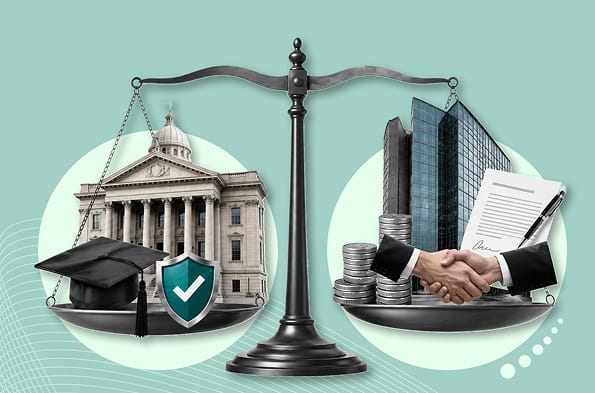
Refinancing federal loans: the trade-off
Which move fits your situation?
Private loans or federal loans on a standard plan, stable income, credit score mid-700s or higher.
This is the profile refinancing was built for. Compare fixed-rate offers from multiple lenders and check whether the total cost of a new loan comes out below your current one over a term you can sustain.
If you're unlikely to use federal repayment or forgiveness benefits, the trade-off may be smaller — but refinancing federal loans still permanently removes those protections, including options that could become valuable if your circumstances change.
You work for a qualifying government or nonprofit employer, working toward forgiveness after 120 qualifying payments.
Do not refinance the federal loans you're using for PSLF. (Any separate private loans can still be refinanced.)
Refinancing federal loans to a private lender ends their PSLF eligibility permanently. You'd trade a potential full balance write-off for a lower rate — rarely worth it if you're on track.
You're a freelancer, between jobs, or your income swings year to year.
Lean toward keeping federal loans and choosing the federal plan that best fits, rather than refinancing.
Federal income-driven plans flex with your income and offer standardized forbearance if things go sideways. Some private lenders offer hardship relief too, but it varies by lender and is generally less extensive. That flexibility has real value when your paycheck isn't predictable.
When refinancing private student loans is much simpler
Most of this article wrestles with a single hard trade-off: refinancing federal loans means surrendering federal benefits. But if your existing loans are already private, that trade-off disappears — you don't have federal income-driven plans, PSLF, or federal deferment to give up in the first place.
For private-to-private refinancing, the decision collapses to a much cleaner set of questions: rate, fees, term, the lender's hardship policies, cosigner release, and protections like death or disability discharge. There's no federal forgiveness pathway to protect, so if a new lender offers a meaningfully lower total cost without giving up borrower protections you value, private-to-private refinancing can be much easier to justify than refinancing federal debt. It's the borrowers with federal loans who need to slow down and weigh what they'd be giving up.
What if your situation is more specific?

Don't rush into refinancing out of panic. First, log into StudentAid.gov, find your balance and rate, and compare the new federal plans available to you. Only after you know your best federal option should you weigh a private refinance against it. Refinancing is permanent; choosing a federal plan is not.
Consider refinancing only the private loans, or federal loans you're certain you won't need protections on. You can keep your federal loans in the federal system while refinancing private debt to a better rate — you don't have to treat it as all-or-nothing.
A smaller balance usually means fewer dollars available to save through a lower rate, but there's no balance threshold that automatically makes refinancing a bad idea. Compare the interest savings with the value of any federal benefits or private-lender protections you would give up.
Tread carefully. New Parent PLUS loans are not eligible for RAP, and Parent PLUS repayment and consolidation rules changed significantly in 2026. If you already hold Parent PLUS loans and are working toward PSLF, your situation is time-sensitive — verify your specific eligibility directly with your servicer before refinancing or making any other move.
You can typically refinance again if a materially better rate appears, though each refinance involves a new application and credit check. This is an argument for not over-optimizing the timing — capture a solid rate now if the spread justifies it, rather than waiting indefinitely for a bottom you can't predict.
Your simple next step
Before you do anything else, pull your actual numbers. Log into StudentAid.gov to review your federal loans, balances, servicers, and rates. For any private student loans, check your lender or servicer accounts and recent loan statements. Then calculate your current total interest cost over your remaining term.
Then, unless you're relying on those federal loans for PSLF or need federal income protections, prequalify with a few lenders to see real offers. Prequalifying with multiple lenders typically uses a soft credit inquiry that does not affect your credit score, making it possible to compare estimated offers before submitting a full application. Compare each offer's total cost against your current loan, holding the term constant, and favor the shortest term you can comfortably afford.
The decision rule is a comparison, not a magic number: if a fixed-rate offer produces a lower total cost than your current loan over a term you can sustain, and you don't need the federal safety net, refinancing is likely worth it — even a modest rate drop can clear that bar on a large balance. If the numbers are close, or you value the flexibility, keep what you have without second-guessing it. If you're comparing lenders, our student loans hub and the breakdown of federal vs. private student loan penalties are good places to see your options side by side.
The bottom line
Refinancing in 2026 is a math problem with one hard veto. If you're using federal loans for Public Service Loan Forgiveness, don't refinance those loans — no rate is worth forfeiting a full balance write-off. For everyone else, if a fixed-rate offer lowers your total cost over a term you can sustain and you don't need federal protections, the savings can be real and substantial. There's no universal rate-drop threshold — run your own numbers first; rates vary by lender and depend on your credit profile.
Compare the numbers with the free loan calculator →
Typically no. Most lenders use a soft credit pull to show estimated rates, which doesn't affect your score. A hard inquiry usually happens only when you formally proceed with an application.
Yes, a private refinance can combine both into one new loan — but doing so converts your federal loans to private and permanently ends their federal protections. Weigh that carefully.
It depends on your risk tolerance and payoff timeline. Fixed rates lock your cost for the life of the loan; variable rates can start lower but rise with the market, subject to the lender's contract terms and any applicable rate cap. For a long payoff horizon, many borrowers prefer the certainty of fixed.
There's no universal threshold. Even a reduction of less than a percentage point can produce meaningful savings on a large balance and a long remaining term, while a much larger drop may still not justify giving up federal protections. Compare the total cost and the benefits case by case rather than chasing a fixed number.